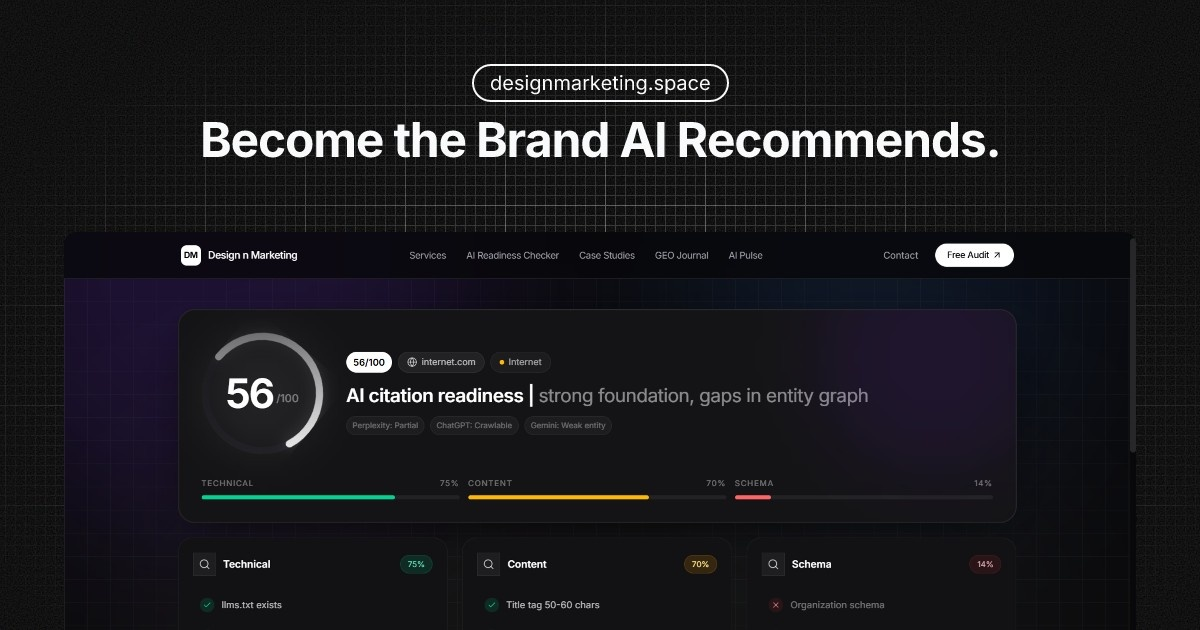
The Complete Guide to AI Search Optimization
AI Search Optimization (AISO/GEO/AEO) explained: how retrieval-augmented generation works, why citations beat rankings, and the five-pillar Citation Authority Model for getting found, understood, and cited by ChatGPT, Perplexity, Gemini, and Google AI Overviews.
Quick Answer
AI Search Optimization, often called AISO, is the practice of structuring a business's content, data, and online presence so that AI systems like ChatGPT, Perplexity, Gemini, Google AI Overviews, and Claude can find it, understand it correctly, trust it, and cite it in the answers they give. Traditional SEO earns a ranking position. AISO earns a mention inside someone else's answer. The two disciplines share a foundation but differ greatly in what "winning" means. One is about being listed. The other is about being quoted.
AI Summaryand
AI Search Optimization, also called Generative Engine Optimization or Answer Engine Optimization, is the discipline of making a business discoverable, understandable, credible, and citable by AI systems that generate answers rather than list links.
Traditional SEO optimizes for rank position in a list of ten blue links, AISO optimizes for inclusion inside a generated answer, often as one of three or four sources an AI model chooses to cite or paraphrase.
Core mechanics involve retrieval-augmented generation, entity recognition, structured data, and trust signals such as reviews, citations, and consistent factual accuracy across the web.
AISO applies across search engines with AI Overviews, standalone AI assistants like ChatGPT and Perplexity, and voice assistants.
Businesses that ignore it risk becoming invisible in an increasing share of buyer research, even while still ranking well on a traditional results page.
Executive Summary
- AI Search Optimization is about being cited inside an answer, not ranked on a results page. The two are related but not the same discipline.
- The underlying mechanism is retrieval-augmented generation, often called RAG. AI systems retrieve relevant documents first, then generate a response grounded in what they retrieved.
- Structured, well-labeled, factually consistent content gets retrieved and cited more often than content optimized purely for keyword density.
- Trust signals that used to be "nice to have" for SEO, such as reviews, third-party mentions, consistent NAP data, and author credentials, are now core inputs to whether an AI system considers a source safe to cite.
- AISO is not a replacement for SEO. It is an additional layer that uses much of the same infrastructure like indexing, crawlability, and schema, but it weights different signals more heavily.
- Measuring AI visibility requires new methods, including prompt testing across multiple AI engines, because there is no single "AI search console" yet.
- The businesses winning early are the ones treating this as infrastructure work now, while most competitors are still treating it as a future problem.
1. What Is AI Search Optimization?
If we conclude it i one sentence, AI Search Optimization is the practice of structuring content and online presence so AI systems can accurately find, understand, and cite a business when generating answers to user queries.
But, if we try to explain it in 3 sentences, instead of ranking a page in a list, AI search systems retrieve a handful of relevant sources and generate a direct answer, often citing two to five of them. Secondly, AI Search Optimization is the set of technical, structural, and trust-building practices that increase the odds a business is one of those cited sources. Thirdly, it draws on SEO fundamentals, including crawlability, structured data, and authority, but reweights them around retrieval and citation rather than ranking.
You will also see this called as Generative Engine Optimization, often shortened to GEO, or Answer Engine Optimization, shortened to AEO. The terms overlap more than they differ. GEO tends to emphasize optimizing for generative engines specifically, such as ChatGPT, Gemini, and Claude. AEO tends to emphasize the older discipline of optimizing for direct-answer boxes like featured snippets, voice search, and People Also Ask section. AI Search Optimization, as we use it here, covers both, because from a buyer's perspective, the distinction rarely matters. What matters is whether your business shows up when someone asks an AI a question that should have led to you.
Why the name matters less than the shift. Whatever you call it, the underlying change is the same. Search is moving from a retrieval interface, which gives you ten links and you decide, to a synthesis interface, which gives you an answer built from a few sources it chose on your behalf. That shift changes who gets found.
Why the terminology is still unsettled, briefly. A genuinely new discipline usually goes through a naming scramble before one term wins out. SEO itself took a few years to settle as the standard term over alternatives in the 1990s. AISO, GEO, and AEO emerged from different starting points. AEO grew out of voice search and featured-snippet optimization work from around 2015 onward. GEO emerged specifically around large language model citation behavior starting around 2023. Terms like AISO are attempts at a broader umbrella covering both. None of the major platforms have standardized on one term in their own documentation yet, which is part of why the space still feels early. We use AI Search Optimization throughout this site because it is the least jargon-heavy of the three to someone encountering the topic for the first time, not because it is more technically correct.
2. Why AI Search Changes Everything
Traditional search put the decision in the user's hands. It gave ten results. The user clicked two or three and formed their own judgment. Being ranked number four still got you traffic, because users scanned the whole page.
AI search puts the decision in the model's hands. A user asks "what is the best project management tool for a 10-person agency," and the model picks three or four answers, weighs them, and presents a synthesized recommendation. If your business is not one of the sources the model retrieved and trusted enough to cite, you do not get a lower position. You get no mention at all. There is no page 2 to fall back on.
This changes the economics of visibility in three ways.
Fewer citations, higher stakes per citation. A results page has ten slots. An AI answer typically cites three to six sources. The competition for each slot is more concentrated, and missing out is more costly. A user reading a generated answer rarely scrolls past it to check alternatives, the way they would scroll past position number four to check position number five on a results page.
Zero-click research becomes the default, not the exception. Traditional SEO already had a zero-click problem. Users got their answer from a featured snippet without visiting a site. AI search intensifies this. The user gets a complete, synthesized answer and may never click through to any source. Visibility inside the answer, being named and being described accurately, starts to matter more than click-through rate.
Trust signals get evaluated computationally, not just editorially. A human scanning search results makes fast trust judgments based on domain familiarity, snippet quality, and visual design. An AI system evaluating sources for retrieval is checking something closer to this. Does this source consistently say accurate things? Is it corroborated elsewhere? Does it have clear authorship? Is the structure machine-parseable? Some of these signals overlap with what humans notice. Many do not.
Not every business feels this shift at the same speed. Categories where buyers research heavily before purchasing, such as software, professional services, and higher-consideration purchases, see AI-assisted research already displacing a meaningful share of traditional search behavior. Categories driven more by immediate, local, or impulse intent, like "pizza near me" or same-day errands, are affected more slowly, since the interaction pattern of opening a map, calling, and going has not shifted as much yet. If your buyers spend real time comparing options before deciding, this shift is probably already affecting you, whether or not it shows up in your analytics yet.
Why this is a revenue question, not just a visibility question. It is tempting to file AISO under "brand awareness," meaning nice to have, hard to attribute, and low urgency. That undersells what is actually at stake. When an AI system recommends three vendors in response to "best [category] for [use case]," those three are effectively getting a warm handoff into a buyer's consideration set, often before the buyer has looked at anything else. Being left out is not a missed impression. It is a missed inclusion in the shortlist a real buyer is about to act on. For high-consideration purchases like software subscriptions, agency engagements, and larger equipment purchases, that shortlist effect compounds. A business absent from three AI-generated shortlists a month, month after month, is not losing a little visibility. It is losing a recurring stream of qualified pipeline it never knew existed, because there is no missed-impression report to point to. This is also why AISO is harder to justify with a traditional ROI calculation early on. The cost is visible and immediate. The benefit is a counterfactual, meaning deals you would have lost anyway to a competitor who was in the shortlist, and that is genuinely difficult to measure until you have a baseline to compare against.
None of this makes traditional SEO obsolete. Google, Bing, and most AI systems still rely heavily on the existing web index. A page that cannot be found by traditional search generally cannot be found by AI search either. AISO builds on that foundation. It does not replace it.
Historical context, briefly. Search has gone through three distinct eras. The keyword era, roughly the 1990s through mid-2000s, matched literal words in a query to words on a page. You could stuff the page with the right phrase and rank. The semantic era, mid-2000s onward, accelerated by Google's Hummingbird update and the Knowledge Graph, shifted toward understanding intent and entities rather than just matching strings, though the output was still a ranked list. The generative era, which is where AISO lives, started when large language models became good enough to synthesize a direct answer from retrieved sources rather than just pointing at them. Each era did not fully replace the last. It added a layer. That pattern is worth remembering, because it means the fundamentals from the earlier eras, such as crawlability, relevance, and authority, still apply. They have just been joined by new requirements on top.
3. AI Search vs. Traditional Search
The mechanics differ enough that treating them as the same discipline leads to blind spots. Here is the comparison.
| Traditional Search | AI Search | |
|---|---|---|
| Output | Ranked list of links | Synthesized answer with citations |
| Success metric | Rank position, click-through rate | Citation, accurate mention, share of voice |
| User behavior | Scans multiple results, clicks several | Reads one answer, rarely clicks through |
| Core algorithm | Ranking, like PageRank and successors | Retrieval plus generation, known as RAG |
| Content unit | Whole page | Passage or chunk within a page |
| Keyword role | Matching signal | Weaker signal. Intent and entity matching matter more |
| Freshness signal | Crawl frequency | Retrieval frequency plus consistency across sources |
| Competitive slots | About 10 per page | About 3 to 6 per answer |
| Measurement tooling | Mature, including Search Console and rank trackers | Immature, mostly prompt-testing based |
The most important row is content unit. Traditional SEO optimizes at the page level. A page ranks or it does not. AI retrieval often works at the passage level. A system might retrieve one paragraph from your page and ignore the rest. That is why a page can rank well in Google and still be poorly suited for AI citation. Its best answer might be buried in paragraph six with no clear structural signal marking it as the answer to anything.
Should you prioritize AI search over traditional search right now? For most businesses, this is a false choice, and it is worth naming directly since it comes up often.
In favor of weighting toward AISO now, early movers in a given category get corroborated and referenced before the space gets crowded, which compounds. The underlying practices like clarity, structure, and honesty improve traditional SEO performance too, so there is little downside risk. Buyer research behavior is shifting quickly enough that waiting has a real cost.
In favor of not over-rotating, AI search still sends a small fraction of the volume traditional search does for most categories today. Measurement tooling is immature enough that it is easy to invest effort you cannot verify is working. A site with weak traditional SEO fundamentals will struggle at AISO regardless, since AISO depends on the same underlying indexing and crawlability.
The practical answer for most businesses is to treat AISO as additive infrastructure work layered onto a healthy SEO foundation, not a replacement priority. Businesses with genuinely strong existing SEO have more to gain from starting AISO work now, precisely because the foundation is already in place.
4. How AI Search Engines Actually Work
Most AI search systems, whether it is Google's AI Overviews, Perplexity, or ChatGPT with browsing enabled, follow a broadly similar pattern called retrieval-augmented generation, often shortened to RAG. Understanding this pipeline is the single most useful thing you can do before optimizing anything.
Step 1: Query interpretation. The system parses the user's question, identifies the entities involved, such as a product category, a location, or a comparison, and determines intent, such as informational, transactional, or comparative.
Step 2: Retrieval. The system searches an index. Sometimes it uses its own web index. Sometimes it uses a search partner's. Sometimes it uses a mix. It pulls back a set of candidate documents or passages that seem relevant to the query.
Step 3: Ranking and filtering. From the retrieved candidates, the system scores and narrows down to a smaller set it will actually use. It weighs relevance, apparent trustworthiness, and redundancy. It generally will not cite five sources all saying the same thing if two will do.
Step 4: Generation. The model writes an answer, grounding its claims in the retrieved passages, and attaches citations to the sources it drew from.
Step 5: Presentation. The answer is shown to the user, usually with clickable citations, sometimes with a "sources" panel.
The practical implication is that you are not optimizing for one algorithm. You are optimizing for a pipeline with two distinct stages that have different requirements. Retrieval rewards clarity and structure, meaning can the system find and correctly parse the relevant passage. Generation-stage citation rewards trust, meaning once retrieved, does the system consider your content reliable enough to attribute a claim to. Most AISO advice conflates these two stages. They need separate strategies, which is what the rest of this guide covers.
A note on vector embeddings, for the technically curious. Much of the "retrieval" step relies on comparing a mathematical representation of your content, an embedding, which is a set of numbers capturing its meaning, against a similar representation of the query, finding the closest matches by semantic similarity rather than exact word overlap. You do not need to manage embeddings directly. They are generated automatically from your existing content. But it explains why a page can get retrieved for a query that does not share a single literal word with it, so long as the meaning is close enough. It also explains why vague, generic phrasing hurts you here. An embedding of a vague paragraph sits in a vague, crowded region of that mathematical space, making it harder to be the closest match to anything specific.
5. Retrieval vs. Ranking
This distinction is worth dwelling on because it is the one most people carry over incorrectly from traditional SEO.
Ranking is comparative and positional. Google decides page A beats page B for a given query and places A higher. Every page on the web is implicitly competing against every other page for the same slot.
Retrieval is inclusive, not positional, at least at first. The system is not asking "which single best page answers this." It is asking "which set of passages, taken together, let me construct a complete and accurate answer." A page does not need to beat every competitor. It needs to be relevant enough, clear enough, and trustworthy enough to be pulled into the candidate set.
This matters practically because it changes what "winning" requires. You do not need to outrank a competitor with ten times your domain authority. You need your specific answer to a specific sub-question to be clearer and more retrievable than theirs. A small, well-structured business with one excellent page on "how much does X cost for a 10-person team" can get retrieved for that query even sitting next to a much larger competitor, because retrieval is asking "does this passage answer the question well," not "which domain is more authoritative overall."
The catch is that retrieval is necessary but not sufficient. Getting retrieved gets you into the candidate pool. Getting cited in the final answer is a separate filter, governed by the trust signals covered in the Credibility and Validation sections below.
A concrete illustration. Two agencies both offer branding services. Agency A has a domain twenty times older, with a hundred pages, and ranks on page one of Google for "branding agency." Agency B is three years old, has fifteen pages, and does not rank on page one for that broad term at all. But Agency B has one page titled "how much does a full brand identity cost for an early-stage startup," with a clear, specific answer up top. When a founder asks an AI assistant that exact question, Agency B's page is a closer semantic match to the specific query than anything on Agency A's broader, less specific site. It gets retrieved and cited, despite losing decisively on traditional domain authority. This is the practical difference between ranking and retrieval, played out in a real competitive scenario rather than as an abstraction.
6. Citations Explained
A citation, in the AI search context, is when a generated answer names, links to, or clearly attributes a claim to a specific source. Not every AI answer includes citations. Some AI systems synthesize without attribution. But the trend among major players, including Google AI Overviews, Perplexity, Bing Copilot, and ChatGPT with browsing, is toward showing sources, partly for user trust and partly for legal and accuracy reasons.
Why citations matter more than rank position:
A citation is a direct, attributed mention at the exact moment someone is asking the question your business can answer. It is closer to a strong word-of-mouth referral than a search result. The AI is effectively vouching for you as a credible source on this specific point.
What makes content citation-worthy, as opposed to merely retrievable:
- A clear, extractable claim. Content that states a fact, a number, a definition, or a recommendation plainly, not buried in narrative, is easier for a model to lift and attribute correctly.
- Corroboration elsewhere. If your claim about, say, average implementation time for a piece of software is echoed, not copied, but echoed independently on review sites, forums, or other credible pages, the model has more reason to trust it enough to cite.
- Recency and consistency. A claim that has not changed in eighteen months and matches what is on other current pages reads as more stable than a fresh claim with no external validation yet.
- Named authorship or organizational accountability. Content attributed to a real person or organization with a track record is treated differently than anonymous content.
One nuance worth being direct about is that being quoted and being paraphrased are both forms of citation, but they carry different value. A direct quote with attribution is unambiguous. A paraphrase without a visible link still influences the user's decision, but you get none of the traffic or brand visibility. This is why some AISO practitioners argue the discipline is really about influence, not just citation count. Even uncredited influence on a generated answer shapes what a buyer does next.
Common misconceptions about citations, worth clearing up directly:
- "More content means more citations." Volume without extractable, specific claims does not help. A hundred vague pages lose to ten sharp ones.
- "Citations are permanent once earned." They are not. A source that goes stale, gets contradicted elsewhere, or stops being updated can quietly lose citation share to a fresher competitor, without any warning.
- "Keyword-optimized content will naturally get cited." Keyword density was a ranking signal, not a citation signal. A page can be perfectly keyword-optimized and still fail to produce a single extractable, quotable claim.
- "If you are not cited, you are not being used." Some AI systems paraphrase without attribution. Absence of a visible citation does not always mean absence of influence. It can just mean the influence is invisible to you.
7. Entities Explained
An entity is a distinct, uniquely identifiable thing, such as a person, place, organization, product, or concept, that a system can recognize regardless of how it is phrased. "Design Marketing Space," "DMS," and "the agency that built [client]'s site" might all refer to the same entity. Search and AI systems increasingly reason in entities rather than keywords. They build an internal model of what exists and how things relate, then match queries against that model.
This is a meaningful shift from keyword-era SEO. A keyword-matching system asks "does this page contain the phrase 'project management software for agencies'?" An entity-aware system asks "is this page about the entity 'project management software,' and does it relate to the entity 'agency,' and how?"
Why this matters for AISO: if your business, your products, and your key concepts are not clearly established as entities, with consistent naming, clear definitions, and unambiguous relationships to other entities, an AI system may fail to connect a user's question to you at all, even if your content technically contains the right words. This is the most common invisible failure mode in AISO. It is not being wrong. It is just being unrecognized.
Practical entity hygiene:
- Use your business name and product names consistently everywhere. Use the same spelling and the same capitalization across your site, your social profiles, and any directories you are listed in. Inconsistency fragments an entity into what looks like several weaker ones.
- Define what you are in plain language early on key pages. For example, say "Design Marketing Space is a [category] that does [function] for [audience]." Do not assume the category is obvious from context.
- Get listed in the directories and data sources that feed knowledge graphs relevant to your category. This varies by industry, but often includes structured business directories, review platforms, and industry-specific listings.
What fragmentation actually looks like:
| Where It Appears | Version Used | Problem |
|---|---|---|
| Website footer | "Design Marketing Space" | correct, full name |
| LinkedIn page | "DMS Web Design" | Different name entirely |
| Google Business Profile | "Design Marketing Space LLC" | Legal suffix inconsistency |
| Directory listing | "Design Marketing" | Truncated, drops a word |
Each row individually looks like a minor variation a human would easily reconcile. To a system trying to determine whether these all refer to the same entity, they look like weaker, partial signals that may or may not corroborate each other. That reduces confidence rather than reinforcing it. Fixing this is usually a few hours of directory and profile cleanup, and it is disproportionately high-impact for how little effort it takes.
8. Knowledge Graphs
A knowledge graph is a structured map of entities and the relationships between them. For example, this company makes this product, this product is a type of this category, and this person works at this company. Google's Knowledge Graph is the most well-known example, but the underlying concept, a graph database of entities and relationships, is used across major AI systems to ground answers in verified facts rather than relying purely on generated text.
Being represented accurately in relevant knowledge graphs gives an AI system a reliable, structured fact-base to draw on when answering questions about you, instead of having to infer facts from unstructured prose, which is more error-prone and less trusted.
How a knowledge graph gets built, in practice: it is assembled from many corroborating sources, including your own site, Wikipedia and Wikidata where applicable, business directories, news mentions, structured data markup, and social profiles. No single source controls it. This is why AISO work often looks like "get accurately represented in ten places" rather than "fix one page."
A practical distinction worth making clearly, since it is commonly misunderstood: you cannot directly edit a knowledge graph. You can only feed it consistent, structured, corroborated information from enough independent sources that the underlying system has confidence in the facts. This is closer to reputation management than to on-page optimization.
Worked example. A SaaS company launches a new product. Early on, an AI system asked "what is [product]" has almost nothing structured to draw from. It might infer an answer from a single landing page, with no corroboration. Over the following months, the company gets listed on G2 and Capterra, which provides third-party corroboration. It publishes documentation with consistent product naming, which provides internal consistency. It earns a few mentions in industry newsletters, which provides external validation. It adds Organization and Product schema, which provides structured signals. None of these individually "builds the knowledge graph entry." Together, over time, they give any system enough corroborated, structured signal to answer confidently and accurately. That is the actual mechanism behind what looks, from the outside, like "getting into the knowledge graph."
9. Structured Data
Structured data, commonly implemented via schema.org markup, is machine-readable code embedded in a page that explicitly labels what things are. This is a Product. This is its price. This is an Organization. This is a Review. This is an FAQ with these specific questions and answers.
Where regular content requires a model to infer meaning from prose, structured data states it directly. This does not guarantee retrieval or citation, but it removes ambiguity, which lowers the odds of a system misunderstanding or skipping your content entirely.
Schema types most relevant to AISO, by use case:
| Schema Type | What It Labels | Best For |
|---|---|---|
Organization |
Company name, logo, contact info, social profiles | Every business, every page, via site-wide markup |
Article / BlogPosting |
Author, publish date, headline, body | Educational content, guides, research |
FAQPage |
Explicit question-answer pairs | Any page with genuine reader questions |
Product |
Name, price, availability, reviews | Ecommerce |
LocalBusiness |
Address, hours, service area | Local businesses |
HowTo |
Step-by-step instructions | Process and implementation guides |
Review / AggregateRating |
Ratings and review counts | Anywhere social proof exists |
Person |
Named individual, credentials, role | Author bios, expert-authored content |
BreadcrumbList |
Page hierarchy and site structure | Any multi-level site, helps systems understand context |
A common mistake is treating structured data as a one-time technical checkbox rather than an ongoing content practice. Every new article, product, or FAQ section is an opportunity to add markup. Markup that goes stale, like an old price or an outdated FAQ answer, can actively hurt trust once a system catches the mismatch against the live page.
For developers implementing this: structured data is added as JSON-LD in a <script type="application/ld+json"> block, typically in the page <head>. A minimal FAQPage example looks like this:
{
  "@context": "https://schema.org",
  "@type": "FAQPage",
  "mainEntity": [{
    "@type": "Question",
    "name": "Does AI Search Optimization replace SEO?",
    "acceptedAnswer": {
      "@type": "Answer",
      "text": "No. It builds on the same technical foundation and adds a layer focused on retrieval and citation rather than ranking."
    }
  }]
}
The same pattern applies to Organization, Article, Product, and the other types listed above. You use one JSON-LD block per type, with the fields filled in to match the actual page content. Google's Rich Results Test and Schema.org's own validator are the two most reliable ways to confirm markup is implemented correctly before assuming it is working.
On combining multiple types: a single page often warrants more than one schema type at once. A blog post reviewing a product might reasonably carry Article, Review, and Organization markup together, each describing a different aspect of the same page. This is normal and often more accurate than forcing a page into a single type. The main failure mode to avoid is marking something up as a type it is not. Labeling a promotional page as FAQPage just to gain FAQ-format visibility in results, for instance, misrepresents the content and can be penalized once detected.
A misconception worth correcting directly: structured data is not a ranking multiplier. Google has been explicit that adding schema does not directly boost search rankings. Its value is in eligibility and clarity. It makes content eligible for rich results and removes ambiguity for any system parsing the page, human or AI. Treat it as reducing the odds of being misunderstood or skipped, not as a lever that pushes visibility up on its own. Businesses that add markup and see no immediate lift are often experiencing this correctly. The markup was not the thing that was going to move the needle by itself.
The Citation Authority Model: Connecting the Foundations
Everything covered so far, including retrieval, entities, knowledge graphs, and structured data, answers one question. Can an AI system find and correctly understand you? That is necessary. It is not sufficient. A system can understand exactly who you are and still choose not to cite you, because understanding and trust are different problems.
This is the gap our Citation Authority Model is built to explain. It is the framework we use across every guide on this site, so it is worth introducing properly here, once, rather than repeating it as a slogan in every section.
The model breaks citation likelihood into five pillars.
- Discoverability — can AI systems find and access your content at all, including crawlability, indexing, internal linking, and technical accessibility?
- Understanding — can the system accurately parse who you are and what a given page is about, including entities, schema, and semantic clarity?
- Credibility — does your content demonstrate real expertise and trustworthiness, including evidence, transparency, accuracy, and author credentials?
- Validation — do independent sources corroborate what you claim about yourself, including reviews, mentions, directories, press, and community consensus?
- Reinforcement — are you consistently strengthening this over time with fresh content, original research, and recurring mentions, or was it a one-time push that is now going stale?
Sections 1 through 9 of this guide map onto the first two pillars, Discoverability and Understanding. The sections ahead, including Brand Authority, E-E-A-T, and Measuring AI Visibility, map onto Credibility, Validation, and Reinforcement. We will flag the relevant pillar as we go, not because the label matters, but because it helps you see which type of gap you are actually looking at when something is not working. A business with a perfectly structured site that still is not getting cited almost always has a Credibility or Validation gap, not a Discoverability one, and the fix is completely different.
A couple of questions this framework tends to raise:
Is this the same as E-E-A-T? Related, not identical. E-E-A-T, covered in detail below, is entirely about Credibility. It asks whether the content itself is expert and trustworthy. The Citation Authority Model treats E-E-A-T as one input into one of five pillars, alongside separate technical, external, and ongoing dimensions that E-E-A-T does not cover on its own.
Do the pillars carry equal weight? No, and the weight shifts by situation. A brand-new business usually has a Validation gap. Nothing external corroborates it yet, and no amount of on-page work fixes that quickly. An established business with a recent website migration often has a Discoverability gap that is purely technical and fixable within days. The framework does not assign fixed weights. Its usefulness is in isolating which pillar actually explains a given business's specific gap.
Using this as a self-diagnostic. When a business asks "why are we not showing up," the model gives a faster path to an answer than guessing. Ask, in order. Can systems find and access the content at all, which is Discoverability? If yes, can they tell what it is actually about, which is Understanding? If yes, does the content itself read as expert and trustworthy, which is Credibility? If yes, does anything outside the business's own site corroborate it, which is Validation? If all four are solid, is the work recent and ongoing, or a one-time push from a while back, which is Reinforcement? The pillar where the honest answer turns to "no" is where the actual gap is, and it is rarely the one people assume without checking.
10. Brand Authority
(Citation Authority Model — Credibility and Validation pillars)
Brand authority, in the AISO context, is not about brand recognition in the marketing sense. It is about whether independent evidence across the web supports the claim that you are a legitimate, competent source on your topic.
AI systems build a picture of your credibility from signals scattered across many places you do not fully control. These include review platforms, industry directories, press mentions, other websites linking to or referencing you, forum and community discussion, and the consistency of your own claims about yourself over time.
What builds brand authority for AISO purposes, roughly in order of impact:
- Third-party validation you did not write yourself, such as reviews, case studies from clients with permission, press coverage, and being referenced by other credible sites in your space.
- Consistency across every place you appear. If your "founded in" date, your service list, or your pricing philosophy contradicts itself between your site, your LinkedIn, and a directory listing, that inconsistency is itself a negative signal. It suggests unreliable information.
- Original expertise, published where it can be found and corroborated. Genuinely useful, specific content, not restated conventional wisdom, is what eventually gets referenced by others, which compounds authority over time.
- A visible, credible "who is behind this." Anonymous or vague authorship is a quiet trust penalty. A named person or organization with a track record is not.
Example — local business: a regional HVAC company earns brand authority not from its website copy, but from consistent Google Business Profile data, a real volume of specific, not generic, reviews, and being mentioned by name in local news or community forums when people ask for recommendations.
Example — SaaS: a project management tool earns it from independent comparison articles that mention it accurately, a healthy G2 or Capterra review profile, and documentation thorough enough that other sites reference it as the source of truth for how a feature works.
Example — agency: a marketing agency earns brand authority less from its own service pages, which are inherently self-interested, and more from named case studies clients are willing to be quoted on, guest contributions to publications the industry already trusts, and a portfolio that is independently verifiable rather than described only in the agency's own words. An agency claiming "100+ clients served" without any corroborating, named examples reads as an unverified claim rather than a credibility signal.
11. E-E-A-T
(Citation Authority Model — Credibility pillar)
E-E-A-T stands for Experience, Expertise, Authoritativeness, Trustworthiness. This is a framework Google popularized for evaluating content quality, and it maps unusually well onto how AI systems seem to weigh source credibility, even outside Google's own products.
Each component asks a slightly different question.
- Experience — has the author or business actually done the thing they are describing, or is this restated theory? First-hand specificity, including numbers, screenshots, edge cases, and what went wrong, signals real experience in a way generic advice does not.
- Expertise — does the author or business have the qualifications or track record to be credible on this topic?
- Authoritativeness — is this source recognized, by others, as a go-to reference in its field?
- Trustworthiness — is the information accurate, current, transparent about limitations, and free of misleading framing?
Expert Quote
"The businesses that get cited consistently are not the ones with the most content. They are the ones whose content nobody has ever caught being wrong."
What each component looks like in practice, with a short example each:
- Experience — a guide on choosing ecommerce platforms that mentions the specific migration issues encountered moving from one platform to another reads as experience. The same guide written entirely in generalities, like "some platforms are easier to migrate than others," does not.
- Expertise — a legal services page authored by a named attorney with a bar number and firm affiliation carries expertise signals a generic "Legal Team" byline does not.
- Authoritativeness — a cybersecurity firm being cited by name in a journalist's article about a recent breach is an authoritativeness signal no amount of self-published content can fully replicate.
- Trustworthiness — a pricing page that is accurate today and was also accurate six months ago, checkable via cached versions or a visible changelog, is more trustworthy than one with a history of quietly changing numbers without explanation.
A practical distinction: Experience and Expertise are about the person or organization. Authoritativeness is about external recognition. Trustworthiness is about the content itself, on a claim-by-claim basis. A business can be genuinely expert and still lose trust points from one outdated statistic sitting on an old page, because trust, in this framework, is evaluated at the content level, not just the brand level. This is a strong argument for auditing and updating old content rather than only publishing new content.
One nuance worth knowing: E-E-A-T scrutiny is not applied evenly across topics. Content touching health, financial, legal, or safety decisions, sometimes called YMYL, which stands for "Your Money or Your Life," gets held to a visibly higher bar for named expertise and sourcing, because the cost of an AI system citing something wrong is higher. A recipe blog and a page about medication dosages are not held to the same credibility standard, even though both are technically "content." If your category touches health, money, or legal decisions, invest in named, credentialed authorship earlier than this guide's general advice might otherwise suggest.
12. Technical Optimization
(Citation Authority Model — Discoverability and Understanding pillars)
This is the infrastructure layer. None of it is glamorous, and most of it overlaps with good technical SEO, but a handful of specifics matter more for AI retrieval than they do for traditional ranking.
Crawlability for AI-specific bots. Beyond Googlebot, check whether your robots.txt allows or blocks bots used by AI systems, including GPTBot, PerplexityBot, ClaudeBot, Google-Extended, and others. This list changes, so it is worth revisiting periodically. Blocking them is not inherently wrong. Some businesses deliberately opt out. But it should be a decision, not an accident inherited from a template.
Clean, semantic HTML structure. A page with a genuine heading hierarchy, meaning one H1, logically nested H2s and H3s, clear paragraph boundaries, and minimal reliance on JavaScript to render core content is far easier for a retrieval system to chunk correctly than a page where the same information is buried in a script-rendered widget.
Passage-level clarity. Because retrieval often happens at the passage level, not the whole-page level, each section of a page should be able to stand alone and make sense if it is the only part a system retrieves. Avoid sections that only make sense with context from three paragraphs earlier.
Fast, stable page performance. Slow or unstable pages can fail to render fully before a crawler times out, meaning content that exists never actually gets indexed.
Internal linking that reinforces entity relationships. Linking "AI Search Optimization" to your dedicated glossary entry for "structured data," rather than leaving the term unlinked, helps both users and systems understand how your content connects.
Example — enterprise: at enterprise scale, technical optimization is less about any single page and more about governance. Hundreds or thousands of pages need consistent schema implementation, which usually means it is built into a CMS template rather than added page-by-page, plus a process for auditing drift when templates change or content teams work around them.
Example — developer / product-led company: documentation sites are an underused AISO asset. A well-structured docs site with clear headings, one concept per page, code examples in fenced blocks, and a consistent URL structure is often more retrieval-friendly than marketing pages, simply because technical writers already tend to write in the extractable, unambiguous style AI retrieval favors.
Tools required: a schema validator, such as Google's Rich Results Test or Schema.org's validator, a way to inspect rendered HTML versus source HTML, for which browser dev tools are sufficient, and access to edit robots.txt and page templates.
Time required: a full technical audit for a small-to-mid-size site typically takes a few days of focused work. Ongoing maintenance, checking new pages get schema and checking robots.txt after any hosting or CDN change, is closer to an hour or two monthly once the initial audit is done.
Implementation checklist — technical:
- Audit
robots.txtfor AI crawler directives, making sure they are intentional, not default - Confirm core content renders without requiring JavaScript execution
- Add or audit
Organizationschema site-wide - Add
Articleschema to all guides and blog posts - Check heading hierarchy on top pages, one H1 and logical nesting
- Confirm key pages load and render content in under 2 to 3 seconds
- Verify internal links connect related concepts, not just navigation
13. Content Optimization
(Citation Authority Model — Understanding and Credibility pillars)
If technical optimization is about being findable, content optimization is about being usable once found. It is structured so a system can lift a clean, accurate answer from it.
Lead with the answer, then explain. The inverted-pyramid structure journalism has used for a century turns out to be close to ideal for AI retrieval. State the direct answer in the first one to two sentences of a section, then support it. A system retrieving a passage is more likely to use the first clear statement it finds than to dig for one buried at the end of a paragraph.
Write extractable claims, not just accurate ones. "Implementation typically takes two to four weeks depending on team size" is extractable. "Implementation can vary quite a bit, but generally is not too long if the team is organized" is accurate-ish but not usable. There is no clean claim a system can lift and attribute.
Match the granularity of the question. If people ask "how much does X cost," answer that specific question in one findable place, rather than only having pricing scattered across a broader page about your service.
Update rather than only publish. A claim that is three years old and has not been revisited reads as less trustworthy than one with a visible recent update, especially in fast-moving categories. Old content with the current date still on it, unchanged, is arguably worse than clearly labeling it as outdated. The mismatch itself is a small trust penalty.
Avoid the two failure modes at either extreme. Thin content, a page that restates the question without really answering it, fails at Understanding. Padded content, a technically correct answer buried in three paragraphs of preamble, fails at retrieval efficiency. The system has to work harder to find the actual claim, and may retrieve a competitor's cleaner version instead.
Before vs. after, worked example:
Before: "Our pricing is designed to be flexible and scale with your business, so whether you are a small team just getting started or a larger organization with more complex needs, we have options that can work for you."
After: "Plans start at $29/month for up to 5 users. Team plans, up to 25 users, start at $99/month. Enterprise pricing is custom and typically starts around $500/month, based on seat count and integrations required."
The "before" version is friendly and not inaccurate, but it contains no extractable claim. A retrieval system cannot lift a specific answer from it. The "after" version answers "how much does this cost" directly, in a form that can be quoted, compared, and attributed accurately.
14. Prompt Optimization
Prompt optimization is the newest and least standardized part of AISO. It means writing and structuring content with an awareness of how people actually phrase questions to AI systems, which differs meaningfully from how they typed queries into a search box.
Search-box queries tend to be short and keyword-like, such as "best CRM small business." Prompts tend to be longer, more conversational, and more specific, such as "what is the best CRM for a 12-person agency that is already using Google Workspace and does not want a steep learning curve." The second version contains constraints, including team size, existing stack, and ease-of-use preference, that a keyword-optimized page often does not address directly.
Practical approach:
- Map the constraint variations, not just the core keyword. For a given topic, list the qualifiers real users attach when they ask conversationally, such as budget level, team size, industry, technical skill, urgency, and existing tools. Address the common combinations explicitly rather than assuming a generic answer covers them.
- Answer comparative and negative framings, not just positive ones. People ask AI systems "when should you not use X" almost as often as "when should you use X." A page that only makes the positive case is invisible for the negative-framed half of the query space.
- Write in complete, quotable sentences for the specific sub-question, not just the page's main topic. A prompt like "does X integrate with Y" deserves a direct, findable sentence answering exactly that, not an inference from a general integrations page.
This is genuinely difficult to fully control. You cannot predict every prompt phrasing. But the direction of the work is clear. Write for the specific, constrained way people actually ask, not the generic keyword version of the topic.
A few real constraint-based prompts versus the generic content most sites publish:
| Generic Content Covers | Real Prompt Being Asked |
|---|---|
| "Benefits of project management software" | "Is project management software worth it for a 5-person team, or is that overkill?" |
| "Our pricing plans" | "What is the cheapest CRM that still has email automation?" |
| "About our agency" | "Which agencies actually specialize in Shopify, not just general ecommerce?" |
| "Why choose us" | "What should I avoid when hiring an SEO agency?" |
The right-hand column is closer to how people actually talk to an AI assistant, constraints and all. Content written to answer the left-hand column alone will rarely get retrieved for the right-hand column's queries, even though they are topically related. The constraint, such as team size, budget ceiling, specialization, or a negative framing, is often the part of the question that determines whether an answer is actually useful, and it is the part generic content skips.
15. Local AI Search
Local AI search follows the same mechanics as the rest of this guide, layered with location-specific trust signals.
What changes for local businesses: AI systems answering "best [service] near [location]" lean heavily on structured, corroborated location data. This includes Google Business Profile accuracy, consistent name/address/phone data across directories, genuine and specific reviews, and local mentions such as news, community forums, and local business associations.
Example: a family-owned bakery wants to show up when someone asks an AI assistant for a recommendation near a specific neighborhood. The technical content on their website matters less here than an accurate, fully filled-out Google Business Profile, consistent hours and address across every directory they are listed in, recent, specific reviews mentioning what people actually ordered, and any local press or community mentions. Inconsistent hours across platforms is a surprisingly common, surprisingly damaging local trust signal.
Common local mistake: treating the website as the primary lever. For local AI search, the website is often a secondary signal. The primary signals live in the business's footprint across maps, directories, and reviews. This is different enough from typical local SEO advice that it is worth stating plainly. A beautifully designed local business website with inconsistent directory data will lose to a mediocre website with clean, consistent local data every time.
Measuring it: for local businesses, prompt testing should include location-specific phrasing like "near [neighborhood]" and "in [city]" rather than only category-level prompts, since local intent queries retrieve differently than general ones. Cross-check Google Business Profile insights alongside prompt testing. A rise in "how did you hear about us" mentions of AI assistants, tracked informally at the point of sale or booking, is a low-effort signal most local businesses can start collecting immediately.
16. Ecommerce AI Search
Ecommerce introduces a specific challenge. AI shopping assistants and shopping-focused AI Overviews need current, structured product data, including price, availability, specifications, and reviews, and they need it to be reliable, because an inaccurate price or an out-of-stock item cited confidently is a trust failure the system will learn to avoid repeating.
What matters most:
Productschema kept current, not just present. Stale structured data, such as a price that has not synced with the actual store in weeks, is arguably worse than no structured data, because it teaches the system your feed is not reliable.- Review depth and specificity, aggregated via
AggregateRatingandReviewschema, since AI shopping answers frequently synthesize "what do reviewers say" as part of the recommendation. - Clear comparative content. "X vs. Y" and "best [category] for [use case]" pages, written honestly, including where your product is not the best fit, tend to get retrieved for comparison-style prompts more than product pages alone.
- Structured specification data, not just marketing copy. Include dimensions, materials, compatibility, and exactly what a system needs to answer "will this fit" or "does this work with" questions directly.
Example: an ecommerce brand selling ergonomic office chairs benefits more from a well-structured comparison page, such as "which of our three models suits a small apartment vs. a home office," answering real constraint-based questions, than from additional adjective-heavy product description copy.
Measuring it: for ecommerce specifically, watch for AI-assistant referral traffic converting at a different rate than typical organic traffic. Early data across the category suggests AI-referred shoppers often arrive further along in their decision process, having already had questions answered by the assistant, which can mean a shorter path to purchase. This is worth tracking as its own segment in analytics rather than lumping it in with general organic traffic.
17. SaaS AI Search
SaaS buyers research almost entirely through comparison and recommendation queries, such as "best X for Y," "X vs. Z," and "does X have [specific feature]." This makes SaaS one of the categories where AISO has the most direct, traceable path to pipeline.
What matters most:
- Comprehensive, honest documentation that other sites end up citing as the source of truth for how a feature actually works. Documentation quality is an underrated AISO asset because it is exactly the kind of specific, extractable, low-ambiguity content retrieval systems favor.
- Third-party review profiles, such as G2, Capterra, and category-specific equivalents, since "what do reviewers say about X" is one of the most common comparative prompts, and AI systems draw heavily on these platforms as corroborating sources.
- Direct, specific comparison content, including against competitors, written with genuine trade-offs rather than one-sided positioning. A comparison page that only ever favors you reads as marketing, not as a trustworthy source, and is less likely to be cited for neutral comparative prompts.
- A changelog or release notes page that is actually kept current, since "does X support [feature] yet" is a common, time-sensitive prompt.
Example: a project management SaaS company gets cited for "best PM tool for remote teams" not primarily because of its homepage, but because of a detailed, honestly-written comparison page, a strong G2 review profile, and documentation specific enough that a support forum answering "how does X handle recurring tasks" links directly to it as the definitive source.
Measuring it: SaaS prompt panels should specifically include the "vs." and "alternative to" phrasing buyers use during active evaluation, not just category-level "best X" prompts. Being cited favorably in a "[Competitor] alternatives" answer is often a stronger signal of bottom-of-funnel visibility than being included in a broad "best tools" list.
18. Measuring AI Visibility
(Citation Authority Model — Reinforcement pillar)
There is no single dashboard yet that shows "your AI visibility" the way Google Search Console shows ranking data. That is improving. Dedicated AI-visibility tracking tools now exist. But measurement in this category still requires more manual and hybrid effort than traditional SEO.
Core measurement methods, from lightest to heaviest:
- Manual prompt testing. Ask the actual questions your buyers would ask, across ChatGPT, Perplexity, Gemini, and Google AI Overviews, and record whether you are mentioned, how accurately, and whether you are cited or just referenced. This is slow but free, and it is the most direct way to understand what a real buyer would actually see.
- Structured prompt panels. Create a repeatable, dated list of 15 to 30 realistic buyer prompts, tested on a regular cadence. Monthly is reasonable for most businesses. This lets you track change over time rather than relying on a one-off check.
- Dedicated AI-visibility tracking tools. A growing category of tools automates prompt testing at scale across engines and tracks citation frequency and sentiment over time. This is useful once you have enough scale that manual testing becomes impractical. It is overkill for a business just getting started.
- Referral and analytics signals. Some AI systems pass referral traffic that is identifiable in analytics, though this is inconsistent and improving slowly. A rising trickle of traffic from AI-assistant referrers is a useful secondary signal, even without visibility into the underlying prompts.
Cost vs. benefit, honestly stated: manual prompt testing costs time, not money, and is a reasonable starting point for any business. Dedicated tracking tools add real cost, typically $30 to $500+ per month depending on scale and depth, and are worth it once you have enough at stake, such as meaningful revenue tied to buyer research or enough competitors to make manual tracking impractical. But they are not a prerequisite for starting the underlying optimization work described in this guide. Do not let the absence of a measurement budget be a reason to delay the structural work. Measure what you can for free first, and add tooling once you have a specific question the free methods cannot answer.
Try our AI Readiness Checker for a free first pass at where your current site stands on the Discoverability and Understanding pillars. It will not tell you your citation rate, nothing free will, honestly, but it will surface the structural gaps worth fixing first.
Limitations, stated plainly. No prompt panel, however well-designed, captures every way a real buyer might phrase a question, and results can shift between test runs even without any changes on your end, since the underlying models and their retrieval behavior are themselves updated regularly. Treat measurement here as directional. Is visibility trending up or down over a few cycles? Treat it as that, rather than as a precise, stable number. A single test showing zero citations is not proof of failure any more than a single test showing three citations is proof of success.
19. Common Mistakes
Treating AISO as a rebrand of SEO content with no new work. Republishing existing SEO content unchanged, with "AI search" added to the title, does not address retrieval structure, entity clarity, or trust signals, which are the things that actually determine citation.
Chasing structured data while ignoring validation. Perfect schema markup on a page nobody else corroborates still struggles to earn citation. Discoverability and Understanding are necessary. They are not the whole model.
Writing only positive-framed content. Pages that never acknowledge trade-offs or "when not to use this" read as marketing rather than a trustworthy source, and are less likely to be cited for comparative or skeptical prompts, which make up a large share of real buyer research.
Letting old content go stale without updating or retiring it. An outdated statistic or a superseded recommendation, left live and undated, is a quiet trust liability that compounds. One AI system catching one inaccuracy can reduce confidence in everything else on the domain.
Inconsistent facts across platforms. A different founding date, service list, or pricing structure between your website, your directory listings, and your social profiles reads as unreliable data, even when each individual instance is technically defensible.
Optimizing for one AI engine only. ChatGPT, Perplexity, Gemini, and AI Overviews retrieve differently and weight signals differently. A strategy built entirely around what seems to work for one can leave you invisible on the others.
Expecting fast results. Reinforcement, the fifth pillar, is inherently cumulative. Citation authority built over eighteen months of consistent, corroborated, updated content is hard to replicate with a six-week sprint, no matter how well-executed.
Writing exclusively for the AI system and forgetting the human reader. Content stuffed with rigid Q&A formatting and stripped of any real voice or nuance can become technically extractable and simultaneously unpleasant to read. That undermines the human trust signals, such as time on page, return visits, and shares, that feed back into the same authority the content is trying to build.
Blocking AI crawlers by accident, then wondering why nothing is working. A robots.txt inherited from a template, a security plugin with an overzealous bot-blocking default, or a CDN configuration set up before AI crawlers existed can silently prevent any of this work from mattering. This is worth checking first, before anything else on this list.
A composite example of how these mistakes stack. A mid-size B2B company invests in a content push, twenty new articles in a quarter, well-written, genuinely useful. Six months later, visibility has not moved. The actual cause, once audited, is a security plugin installed years earlier that was silently blocking every major AI crawler, which is mistake one. The new articles used three slightly different variations of the product name across the site, which is mistake two. None of the content had been updated since publication despite two pricing changes in the meantime, which is mistake three. No single mistake here was severe. Together, they were enough to make a real, well-executed content investment functionally invisible. That is the more common failure pattern than any one dramatic error.
Your first 30 days, if you are starting from nothing:
- Week 1 — Audit. Run the AI Readiness Checker, check
robots.txtfor accidental AI-crawler blocks, and manually test 10 to 15 realistic buyer prompts across ChatGPT, Perplexity, and Google AI Overviews to see your current baseline. - Week 2 — Fix the foundation. Address whatever the audit surfaced, such as
Organizationschema, heading structure, and entity-name consistency across your site and top directory listings. - Week 3 — Fix the content. Pick your ten most common buyer questions. Make sure each has one clear, extractable, findable answer, following the lead-with-the-answer structure covered above.
- Week 4 — Set up ongoing measurement. Turn the Week 1 prompt list into a repeatable panel, save the results as a baseline, and set a calendar reminder to re-test in 30 days.
This is not the whole strategy. Validation and Reinforcement, the trust-and-consistency pillars, are inherently longer-term. But it is enough to move from zero to a measured, defensible starting position within a month.
20. AI Search Checklist
A condensed, practical starting point. Not every item applies to every business. Use what is relevant.
Foundation
- Business name, product names, and key terms used consistently everywhere
Organizationschema implemented site-widerobots.txtreviewed for AI crawler directives, making sure it is an intentional decision, not default- Core content renders without requiring JavaScript
Content
- Top 10 to 20 buyer questions identified and each answered in one clear, findable place
- Each key page opens with a direct answer before elaboration
- Comparative and "when not to" content exists alongside positive-framed content
FAQPageandArticleschema applied to relevant pages
Trust
- Review profile actively maintained on the platforms your buyers actually check
- Author names and credentials visible on educational content
- Facts, such as dates, pricing philosophy, and service scope, consistent across site, directories, and social profiles
Measurement
- A repeatable list of 15 to 30 realistic buyer prompts drafted for manual or tool-based testing
- A cadence set for re-testing, with monthly as a reasonable default
Ongoing
- A process for reviewing and updating older content, not just publishing new content
- A monthly review of what has changed in how major AI systems present answers in your category
Advanced — for businesses that have the foundation in place:
- Schema implementation built into CMS templates rather than added page-by-page, with a periodic audit for template drift
- A documented process for requesting corrections when third-party directories or review platforms have inaccurate information about you
- Structured outreach for genuine third-party validation, such as contributing to industry publications, being included in comparison content, and earning reviews proactively rather than passively
- Prompt panel testing automated or semi-automated across multiple AI engines, rather than run manually each cycle
- A documented content retirement or update policy, meaning a defined trigger like age, a changed fact, or a product update for revisiting a piece rather than leaving it indefinitely
21. Frequently Asked Questions
Does AI Search Optimization replace SEO?
No. It builds on the same foundation, including crawlability, indexing, and structured data, and adds a layer focused on retrieval and citation rather than ranking. Most businesses need both.
How long does it take to see results?
There is no reliable universal timeline, since it depends heavily on the Reinforcement pillar, which is consistent work over time. Structural fixes, such as schema and technical clarity, can show up in retrieval testing within weeks. Citation frequency, which depends more on accumulated trust, typically takes longer to shift meaningfully.
Can a small business compete with large, established competitors?
Often better than in traditional SEO, because retrieval rewards a specific, well-structured, well-corroborated answer over general domain size. A small business with one excellent, honest answer to a specific question can get retrieved next to a much larger competitor.
Do I need to optimize for every AI engine separately?
Not entirely separately. The fundamentals, including structure, clarity, and corroboration, transfer across engines. But it is worth testing across the major ones, such as ChatGPT, Perplexity, Gemini, and Google AI Overviews, since they retrieve and weight signals somewhat differently.
Is this the same as buying ads inside AI chat tools?
No. AISO is about earning organic citation through structure and trust. Paid placement inside AI assistants is a separate, still-emerging category with different mechanics.
What is the single highest-impact first step?
For most businesses, pick your ten most common buyer questions, and make sure each has one clear, direct, findable answer somewhere on your site. It is unglamorous, but it addresses Discoverability, Understanding, and Content Optimization at once.
Should I block AI crawlers to protect my content from being used to train models?
That is a legitimate business decision, and it is a different question from AISO. Blocking bots like GPTBot prevents that content from being used in model training by that specific company, but it also generally prevents that content from being retrieved and cited in that system's live answers. Some businesses accept the training trade-off deliberately. Others decide visibility matters more. There is no universally correct answer. It depends on what you are optimizing for.
Does this apply to voice assistants too?
Largely yes. Voice assistants answering spoken queries rely on similar retrieval and direct-answer mechanics, often pulling from the same underlying structured data and featured-snippet-style content. The core practices in this guide transfer.
What happens if an AI system cites me inaccurately?
This does happen, and there is no formal correction process across most platforms yet, though some offer feedback mechanisms. The best defense is prevention. Unambiguous, clearly-stated claims are less prone to misinterpretation than vague or heavily qualified ones, and consistent facts across multiple sources give a system more reason to get it right in the first place.
Do I need a large content library before starting?
No. This is one of the more common reasons businesses delay unnecessarily. A handful of pages that clearly, accurately answer your most common buyer questions outperforms a large library of thin, generic pages. Start with the ten questions your sales or support team hears most often, and expand from there.
Is AISO worth doing if my category has almost no competition doing it yet?
Often the best time to start, not a reason to wait. Reinforcement, the fifth pillar, rewards consistency accumulated over time, which means starting before competitors creates a compounding head start that is harder to close later than it is to build now.
22. The Future of AI Search
The sections above are grounded in how retrieval and generation currently work. This section is more speculative. It is clearly labeled as our editorial view, not established fact.
Multi-turn retrieval will likely matter more than single-query optimization. As AI assistants handle longer conversations with follow-up questions, being the right answer to a narrow first question may matter less than being a consistently reliable source across a whole line of related follow-ups.
Verification and corroboration requirements will likely tighten, not loosen. As AI systems face more scrutiny over citing inaccurate or manipulated sources, expect stronger weighting toward corroborated, multi-source-verified claims and correspondingly less tolerance for single-source, unverifiable assertions. That raises the value of genuine third-party validation over time.
The gap between "optimized for AI" and "just genuinely well-structured and honest" will likely narrow. Much of what currently reads as a specialized AISO tactic, including clear answers, honest trade-offs, consistent facts, and real expertise, is close to what good editorial practice has always looked like. Our view is that the businesses treating this as "how do we write well and prove we are trustworthy," rather than "how do we game a new algorithm," will be the ones still working a few years from now, regardless of how the specific mechanics shift.
Measurement tooling will mature faster than the underlying strategy needs to change. Expect a "Search Console for AI search" equivalent within the next couple of years, from either an existing SEO platform extending into this space or a new entrant built for it specifically. When it arrives, it will make the manual prompt-testing methods in this guide faster to execute, not obsolete. The strategic groundwork, including structure, corroboration, and honesty, will still be the thing the tool is measuring.
We will revisit and update this section as the category matures. This is exactly the kind of claim we intend to hold ourselves accountable to.
23. Conclusion
AI Search Optimization is not a trick layered on top of SEO. It is what happens when you take "be genuinely findable, understandable, and trustworthy" seriously enough to build real infrastructure around it. The five pillars of the Citation Authority Model, Discoverability, Understanding, Credibility, Validation, and Reinforcement, give you a way to diagnose which part of that infrastructure is actually missing, rather than guessing.
Start with the questions your buyers actually ask. Answer them clearly, in one findable place each. Make sure the facts about your business are consistent everywhere they appear. Then keep at it. This category rewards consistency more than any single well-executed sprint.
One last thing worth being honest about. A guide this length can make AISO sound like a finite project with an end state, meaning audit, fix, done. It is not. The Reinforcement pillar exists precisely because the businesses that treat this as ongoing infrastructure, revisited monthly rather than fixed once, are the ones still visible a year from now, while the ones who treated it as a one-time sprint quietly fade as their content ages and competitors catch up. This guide itself will be revisited and updated as the underlying systems change. That is the standard we are holding our own advice to, not just yours.
If you want a starting diagnosis, the AI Readiness Checker is free and takes a few minutes. For ongoing coverage of what is changing in this space, the monthly AI Pulse newsletter tracks it as it happens.
Terminology
A quick reference for the terms used throughout this guide.
| Term | Plain-English Meaning |
|---|---|
| AISO | AI Search Optimization, which means structuring content so AI systems can find, understand, and cite it |
| GEO | Generative Engine Optimization, largely interchangeable with AISO, emphasizes generative AI engines specifically |
| AEO | Answer Engine Optimization, the older term, emphasizes direct-answer formats like featured snippets |
| RAG | Retrieval-Augmented Generation, the pipeline where an AI system retrieves sources, then generates an answer grounded in them |
| Entity | A distinct, identifiable thing, such as a person, business, product, or concept, that a system can recognize across different phrasings |
| Knowledge graph | A structured map of entities and the relationships between them |
| Schema markup / JSON-LD | Machine-readable code that explicitly labels what content is, such as a product, a review, or an FAQ |
| E-E-A-T | Experience, Expertise, Authoritativeness, Trustworthiness, a framework for evaluating source credibility |
| Citation | An AI-generated answer naming, linking to, or attributing a claim to a specific source |
| Embedding | A mathematical representation of content's meaning, used to match queries to relevant passages by similarity rather than exact wording |
Key Takeaways
- AI Search Optimization is about earning citation inside a generated answer, not rank position on a results page.
- Retrieval-augmented generation, or RAG, is the underlying mechanism most AI search systems share. They retrieve, filter, generate, and cite.
- The Citation Authority Model's five pillars, Discoverability, Understanding, Credibility, Validation, and Reinforcement, map to distinct, diagnosable gaps.
- Structured data and technical clarity get you retrieved. Corroborated trust signals get you cited. They require different work.
- Measurement currently requires manual or hybrid prompt testing. There is no single mature "AI search console" yet.
- This rewards consistency over time more than a single optimization push.
Further Reading
- AI Readiness Checker — a free, structural first pass at your Discoverability and Understanding pillars
- AI Pulse — our monthly newsletter tracking what is changing in AI search
- AI Search Intelligence services — how we work with businesses on this directly
- Case studies — real work, real outcomes

Zain Kazmi
Founder, DesignnmarketingFounder of Designnmarketing - AI Search Optimization (GEO) agency helping brands become the answer AI cites inside ChatGPT, Perplexity, Google AI Overviews, Gemini, Claude & Grok.